Strong analysis, communication, and liaison skills between military, academic, and business organizations.
Project management, research design and analysis, problem identification and solving innovations. Self-starter or team focused.
Functional skills and experience in Management, Marketing, Education and Training, Human Resources, Human Factors (GUI and HSI), Organizational Behavior, Statistics, and Military Organizations.
Strong personal and mainframe computer skills including Word, Excel, PowerPoint, SPSSX (mainframe and PC), as well as STILAS, ERIC, and other CD-ROM databases. E-mail, msg, ftp, telnet, gopher and VI experience. Home page (html) design and construction experience (e.g., this page).
Security Classification level provided as necessary.
Ongoing training, including the following courses: Team Facilitation, High Impact (Visual Aids) Workshop, SSC-SD System Engineering, Lean Six Sigma, and Acquisition Reform courses. Also completed Iridium beta training on September 30, 1998, and Open Source Intelligence Basic Training on February 7, 1999.
Employed for more than a decade at the Space and Naval Warfare Systems Center - San Diego, Command and Control (C2) Department: Currently working in support of the DISA IRC-XMPP Chat study, and prior to that for DISA's Net-Enabled Command Capability (NECC) program. Previously, I worked in support of the DARPA Augmented Cognition project. Earlier my work included two projects: (a) An Air Force Information Warfare Combat Assessment Tool, and (b) a DARPA cognitive support assessment for the Tomahawk Strike Coordinator. Prior to that my work involved the FORCEnet Human System Integration effort at NETWARCOM. Before that, I managed the experimental design and metrics for the Information Operations C2 Experiments project designed to assure computer network operations and defense using embedded firewalls (EFW). I have also worked on the Commander in Chief Twenty-First Century (CINC 21) advanced collaborative technology project. Also served as project manager for the RPM (CO/TAO tactical decision support tool) project. Previous tasks included
Principle Investigator for DRAD (Disaster Relief Anchor Desk, including the Disaster Related Index, as well as providing support for the PMAD (Political Military Anchor Desk), the Coast Guard NDS [National Distress System (upgrade)], and DARPA's CPOF (Command Post of the Future) projects. A recent task supported a Center-wide initiative to address crisis response and management linking both civil and military participants to any domestic crisis. Also, served as the technical lead during the ELB (Extending the Littoral Battlespace) ACTD Demonstration I, a joint military demonstration project by the Office of Naval Research (ONR) and the Commander in Chief of the Pacific (CINCPAC). Other work included ONR's Open Source research and development VICTOR (Virtual Information Center Technologies to support Open-source Requirements) project.
California State University at Northridge: Taught twenty-two undergraduate and graduate courses about management history, theory, and practice, including motivation, goal theory, research, leadership, etc.
Naval Health Research Center: Served as project manager or worked on R&D efforts concerning small group effectiveness in the Antarctic, Navy physical fitness evaluations, and habitability.
Navy Personnel Research & Development Center (former name). Served as principal investigator and worked on R&D efforts concerning the Naval Academy graduate evaluation program, basic skills and study factors, survey design, and several USMC tasks including CSS and maneuver warfare.
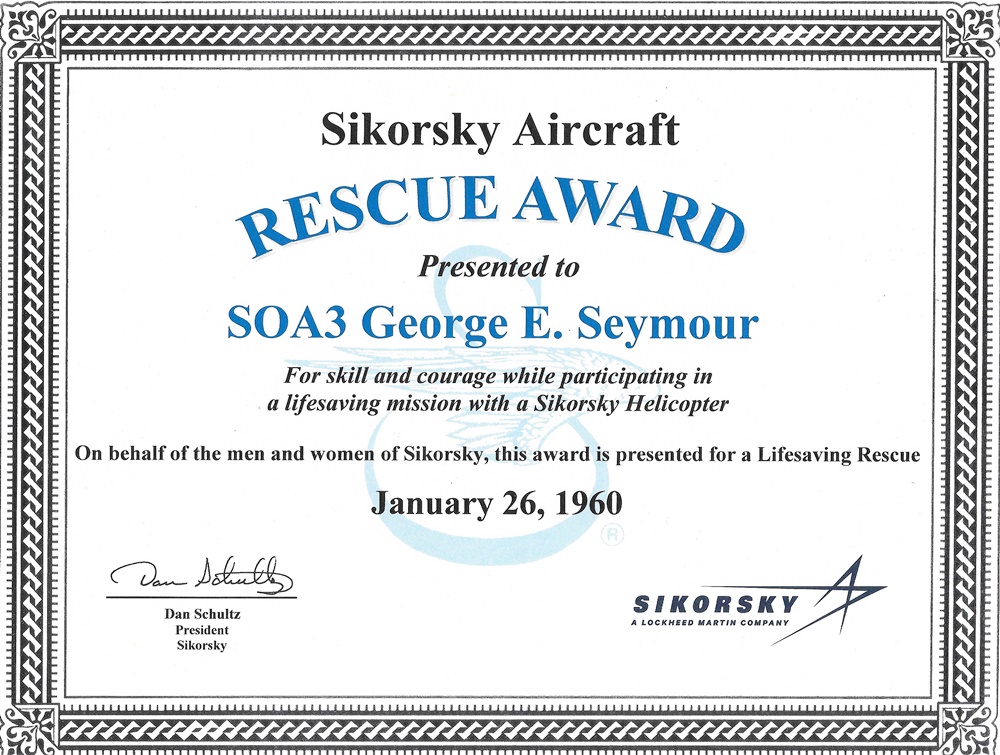
U. S. Navy: Served four years performing ASW in training and operations, accumulating more than 600 flight hours in helicopters. Successfully completed the week long Survival, Evasion, Resistance & Escape (SERE) school.
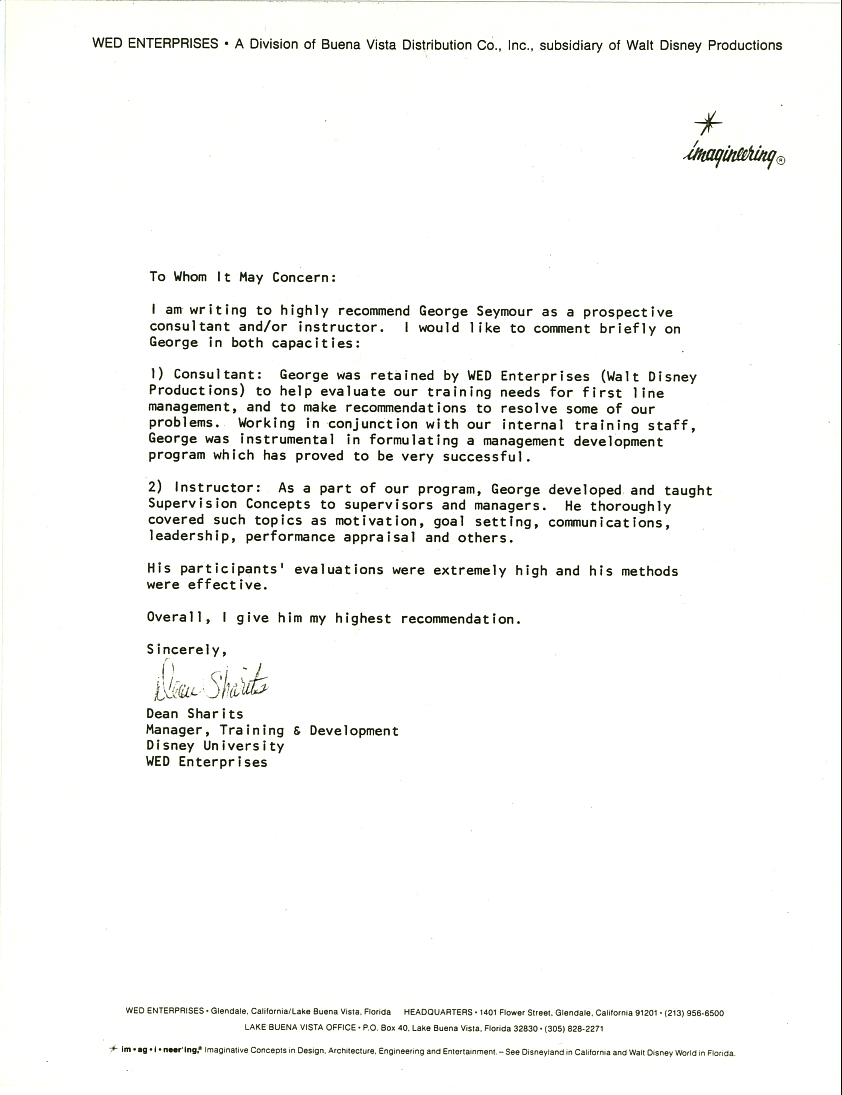
Walt Disney, Inc.: Consulting work, as well as designed and taught two supervision courses at Disney University: View.
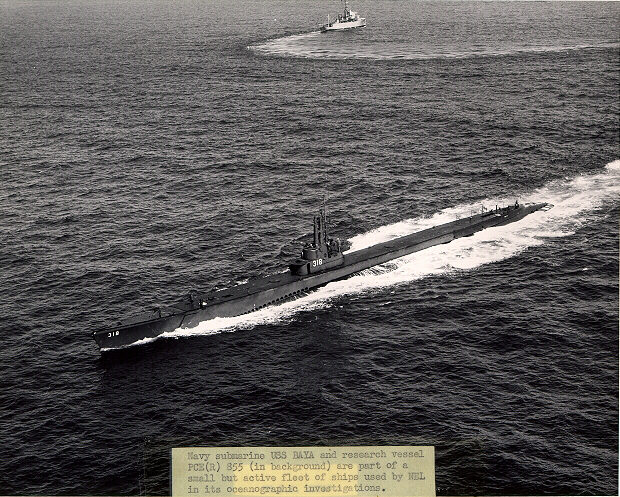
Gales, R.S., Hershman, R.L., Klump, R.G., McDonald, B., Naitoh, P., and Seymour, G.E. (1971). Effects of exposure to airborne sound of sonar pings:
Report of Project Ping-Phase I. Naval Undersea Research and Development Center Technical Publication, 297.
Marx, M.H., Pavur, Jr., E. J., & Seymour, G.E. (1977). Differential recall of problems. clues, and solutions from completed and uncompleted tasks. Bulletin of the Psychonomic Society, 9, 322-324.
Conover, J.N., Seymour, G.E., Marx, M.H., & Moore, M.M. (1978). Stereotyped
personality trait ratings of concrete and "typical" stimulus persons. Bulletin of the Psychonomic Society, 12, 400-402.
Seymour, G.E. (1978). Archanalysis: A quantitative review method for social science. Unpublished dissertation: University of Missouri--Columbia, Mo.
Cooper, H. M., Burger, J. M., & Seymour, G. E. (1979). Classroom context and student ability as influences on teacher perceptions and classroom
control. American Educational Research Journal, 16, 189-196.
Lammers, H.B., Leibowitz, L., Seymour, G.E., and Hennessey, J. (1981). Immediate and delayed effects of humor on cognitive responses to advertising
stimuli. Paper presented at the meetings of the Western Psychological Association, Los Angeles.
Lammers, H.B., Seymour, G.E., & Wilkinson, M.L. (1981). Source expertise and self-focused attention effects on biased scanning of advertisements.
Paper presented at the annual meeting of the American Psychological Association, Los Angeles, CA.
Lammers, H.B., Leibowitz, L.E., Seymour, G.E., & Hennessey, J. (1983). Immediate and delayed effects of humor on cognitive responses to advertising
stimuli: A trace consolidation approach. Journal of Business Research, 11, 173-185.
Seymour, G.E. (1986). U.S. Naval Academy graduate performance evaluation system: Analysis of the 1985 survey. Navy Personnel Research and Development
Center Report, (unpublished technical report).
Seymour, G.E. (1986). Sex differences in training perceptions among recent Naval Academy graduates. Navy Personnel Research and Development Center
Report, (unpublished technical report).
Seymour, G.E. (1987). Types of ambiguous significance in multivariate analysis of variance. Social and Behavioral Sciences Documents, 17, 6.
Seymour, G. E. (1990). Dividing designs: Generic and unique rules for most common personal computer systems. Personal Systems: The Journal of the
San Diego Computer Society, 16, 14-16.
Morris, B. A., Main, R. E., Randel, J. M., & Seymour, G. E. (1991). Front-end analyses of three Navy electrical/electronic technical schools
in the Model Schools Program. Navy Personnel Research and Development Center Technical Note 91- 19.
Seymour, G. E. (1992). USMC Combat Service Support Survey. Navy Personnel Research and Development Center Letter Report: May 22.
Seymour, G. E. (1994). Over-the-Horizon: Lessons from the OTH Project. Navy Personnel Research and Development Center Technical Note. (Unpublished report).
Wetzel, C. D., Simpson, H., & Seymour, G. E. (1995). The use of videoteletraining to deliver chief and leading petty officer Navy leadership training. Navy Personnel
Research and Development Center Technical Report 95-8. (3 MB PDF file: download.
Seymour, G. E. (1996). Cognitive Structure and Academic Performance. Navy Personnel Research and Development Center Technical Report. (unpublished technical report).
Wetzel, C. D., Radtke, P. H., Parchman, S. W., & Seymour, G. E. (1996). Delivery of a Fiber Optic Cable Repair Course by Videoteletraining. Navy Personnel Research and Development Center Technical Report 96-4.
(6 MB PDF file: download).
Seymour, George E. (1997). C3*2: Command, Control, and Communications for Community Crisis Coordination. Space and Naval Warfare Systems Center, San Diego. (unpublished report.
St. John, M, & Seymour, G. E. (1997). Do Displays of Tactical Response Options Influence Expert Decision Making? Poster Session at the annual convention of the Human Factors and Ergonomics Society, Sept. 22, Albuquerque, NM.
Seymour, G. E. (1998). The Disaster Management Anchor Desk. Poster Session at the
third annual FEMA Technology Solutions for Emergency Management Challenges Workshop, July 21, 1998 at the Argonne National Lab.
Seymour, G. E. & Kelly, R. (2000). Technology Insertion: A GOTS Case Study. Space and Naval Warfare Systems Center, San Diego. Unpublished Report.
Seymour, G. E. & St. Clair. (2000). Information Operations Command & Control: The Impact of INFOCON Levels on Simulated Fleet Operations. Space and Naval Warfare Systems Center, San Diego. Special Report: (FOUO).
Seymour, G.E., St. Clair, C., & Zimmerman, L. (2000). The Effects of INFOCON Levels on Fleet Operations. Space and Naval Warfare Systems Center, San Diego Technical Report Number 1846: (FOUO).
St. Clair, C., Seymour, G. E., & Zimmerman, L. (2003). Information Operations Command and Control Experiments: Dynamic Network Defense. Space and Naval Warfare Systems Center, San Diego Technical Report 1900: (FOUO).
Seymour, G.E., St. Clair, C., & Zimmerman, L. (2003). Information Operations Command and Control (IOC2) Dynamic Network Defense Experiment Research Findings. In: Space and Naval Warfare Systems Center, San Diego Biennial Report.
Seymour, G.E. (2004). Joint PAT addresses Center's jointness issues.” Space and Naval Warfare Systems Center Outlook, 16 July 2004, Volume 27, Number 13.
Osga, G., Linville, M., Guerlain, S. O'Hargan, K., Seymour, G., Thomas, T., Treat, T. & Weaver, J. (2004). Tomahawk Strike Coordinator Cognitive Task Analysis. Space and Naval Warfare Systems Center Technical Report 1919.
Seymour, G. E. & St. Clair, C. (2005). IWCAT Operational Assessment: The U.S. Air Force Information Warfare Combat Assessment Tool Operational Assessment. Space and Naval Warfare Systems Center Technical Report 1923.
Seymour, G. E. & Van Horn, S. (2006). “HSI at the Deck plates: Navy Human Systems Integration OIF Lessons Learned,” Space and Naval Warfare Systems Center Biennial Review.
Organizational Activity:
Vice President and President, Chiricahuas (Special interest club), Southwestern Jr. College, 1964-65.
President-elect and President, Council for Exceptional Children (Chapter 555), San Diego State University, 1966-1967.
Student Representative, Campus Computing Policy and Review Committee, University of Missouri, 1974-1976.
Representative at Large and President, Graduate Student Association, University of Missouri, 1974-1976.
Student Representative, Graduate Faculty Senate Executive Committee, University of Missouri, 1975-1976.
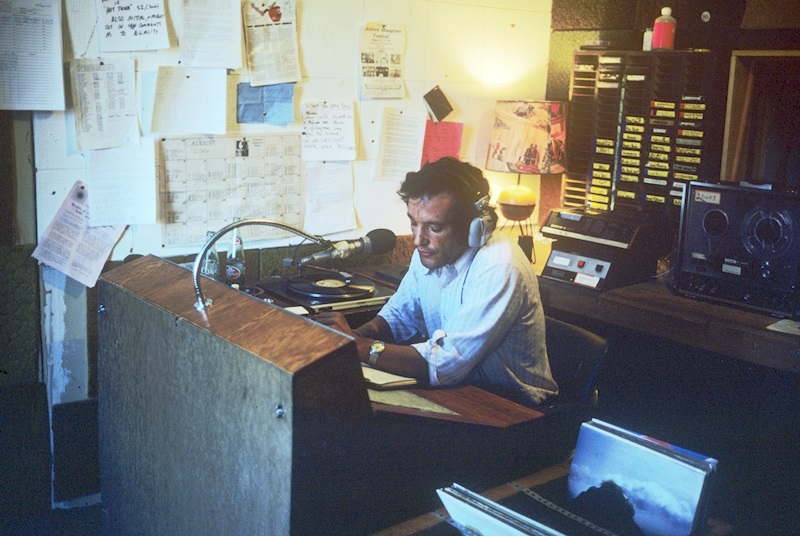
Volunteer Radio Disk Jockey (Program Announcer): FM station KOPN, Columbia, Missouri, 1975.
Student Representative, Faculty Research Council, University of Missouri, 1976-1977.
Faculty Advisor, Student Management Association, California State University-Northridge, 1980-1981.
Associate Editor, Division 23 Newsletter, American Psychological Association, 1984-1985.
Abstracts Editor, Division 23 Newsletter, American Psychological Association, 1985-1987.
Executive Committee member, Division 23, American Psychological Association, 1986-1987.
Workshop volunteer for School of Business simulation training, University of San Diego, 1991.
Panel Chair for Decision Making session at the 34th Annual Military Testing Association meeting on October 28, 1992.
Invited panel discussion leader for the Combat Decision Making Symposium at the Marine Corps Command and Staff College, May 7-9, 1993.
Invited presentation titled "Assessment 2000: New Approaches to Performance Assessment in the Military: Implications for Workforce Education" for the Department of Educational Technology, San Diego State University on October 6, 1993.
Volunteer Junior Achievement Consultant (1993-1994) at Madison High School and Ocean Beach Elementary School.
Vice President and President, San Diego Webmasters' Alliance (later, San Diego WebBuilders (1997 to 1998).
Panel Chair for a Seminar titled, "The State of Webmastering" at the San Diego Computer Expo on August 21, 1997.
Department representative to the Center-wide Crisis Consequence Management initiative (1997-1998). February 5, 1999 Outlook article.
Invited presentation titled, "InterNet Search: State of the Art" for the San Diego Chapter of the Human Factors and Ergonomics Society on February 24, 1998.
Presented a wireless communication technology demonstration that supports crisis first-responders at the third annual FEMA Technology Solutions for Emergency Management Challenges Workshop, July 22, 1998 at the Argonne National Laboratory. September 21, 1998 Outlook report.
Invited presentation titled, "Crisis/Consequence Management: The Asymmetric Threat to Our Communities." for the San Diego Chapter of the Human Factors and Ergonomics Society on November 12, 1998.
Served as the technical and team leader during two weeks at sea on the USS Bonhomme Richard, LHD 6, in support of the joint ELB ACTD (Extending the Littoral Battlespace Advanced Concept Technology Demonstration) from April 4 to April 16, 1999.
Hospitality Committee co-chair and tour guide for the IEA 2000 / HFES 2000 Triennial Congress in San Diego from July 30 to August 4, 2000.
Invited presentation titled, "Information Operations Command & Control: The Impact of INFOCON Levels on Simulated Fleet Operations," for the NROTC unit at the University of San Diego, November 27, 2000.
K-8 school science advisor and volunteer for (a) science project evaluation form design, (b) science project judging, and (c) classroom reading. (1993-2001).
Department Representative to Space and Naval Warfare Systems Center Business Process Improvement Team (1999 to present).
President of the San Diego Chapter of the Human Factors and Ergonomics Society. (2002-2003).
Presentation titled, "COTS Collaboration Tools for C4: Then and Likely Future." Office of Naval Research TC3 Conference and Workshop held in San Diego January 15-17, 2002.
San Diego HFES Chapter Honors Student Science Projects, April 25, 2002. Reported also in the SSC-SD Outlook.
Ongoing Site Manager for two Virtual Program Offices (COTS Collaboration and Knowledge Management).
Presentation titled, "Human Error: Perennial and Pervasive" at the Human Factors and Ergonomics Society's San Diego Chapter's 9th Symposium, in San Diego on March 8, 2003.
Member of the USJFCOM Human Systems Integration Working Group (2003 - 2004).
Presentation titled, "FORCEnet Update Report" at the Naval Network Warfare Command FORCEnet OAG meeting on October 28-30, 2003 at Camp Pendleton, CA.
Presentation titled, "HSI Lessons Learned: FORCEnet Update Report" at the Horizontal Integration Training Strategy meeting on November 18, 2003 at the Space and Naval Warfare Systems Command, San Diego, CA.
Presentation titled, "HSI Lessons Learned: Status Report" at the FORCEnet HSI Working Group meeting on April 7, 2004 at the Camp Pendleton, Marine Corps Base, CA
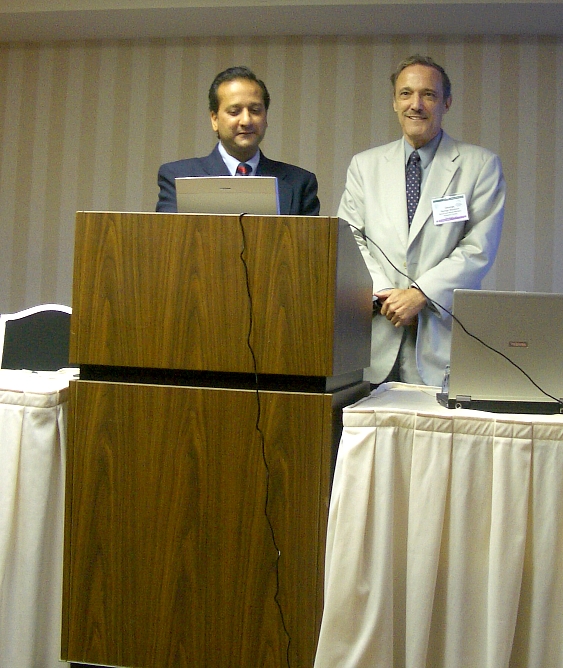
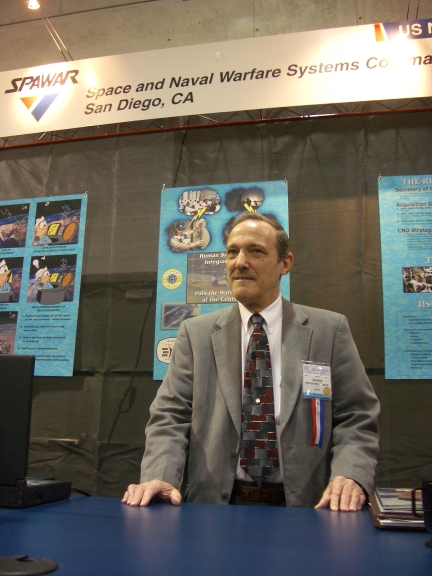
Presentation titled, "HSI @ The Deckplates: A Brief Overview" at the 44th annual meeting of the Human Factors and Ergonomics Society in New Orleans on September 21, 2004. [Photo]
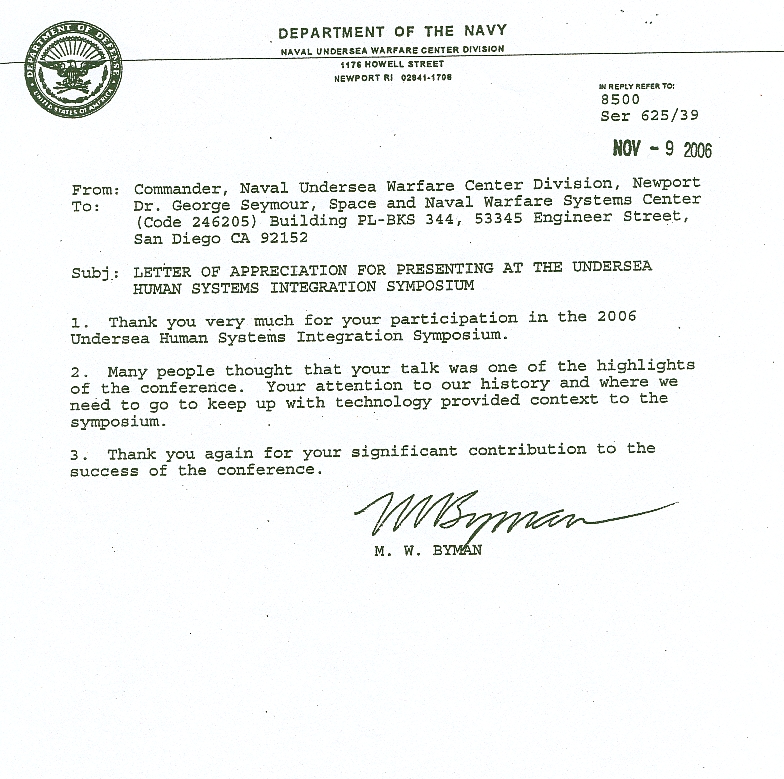
Invited presentation titled, "Digital Collaboration Tools in the Military: Their Historical and Current Status" for the Office of Naval Research CKM Workshop on January 24, 2006, at the MIT Stata Center, Boston, MA.
1972: Letter of Appreciation from the Naval Undersea Research and Development Center (later NRaD, then SSC-SD) for work on Project Ping.
Listed in:Who's Who Among Students in American Universities and Colleges, 1975/1976. Who's Who in the Midwest, 16th and 17th editions. Dictionary of International Biography, Volume 15.
1986: Special Achievement Award from Navy Personnel Research and Development Center for efforts associated with the US Naval Academy GRAPES project.
1987: Sustained Superior Performance Award from Navy Personnel Research and Development Center for both Center and project contributions.
1990: Performance Award from Navy Personnel Research & Development Center.
1991: Sustained Superior Performance Award from Navy Personnel Research & Development Center.
1991: Community Service Award for efforts associated with the Combined Federal Campaign.
1992: Outstanding Performance Award from Navy Personnel Research & Development Center.
1993: Presentation award for support provided during the May 7-9 Combat Decision Making Symposium at the U. S. Marine Corps Command and Staff College.
1994: Certificate of Appreciation from Junior Achievement for consulting services.
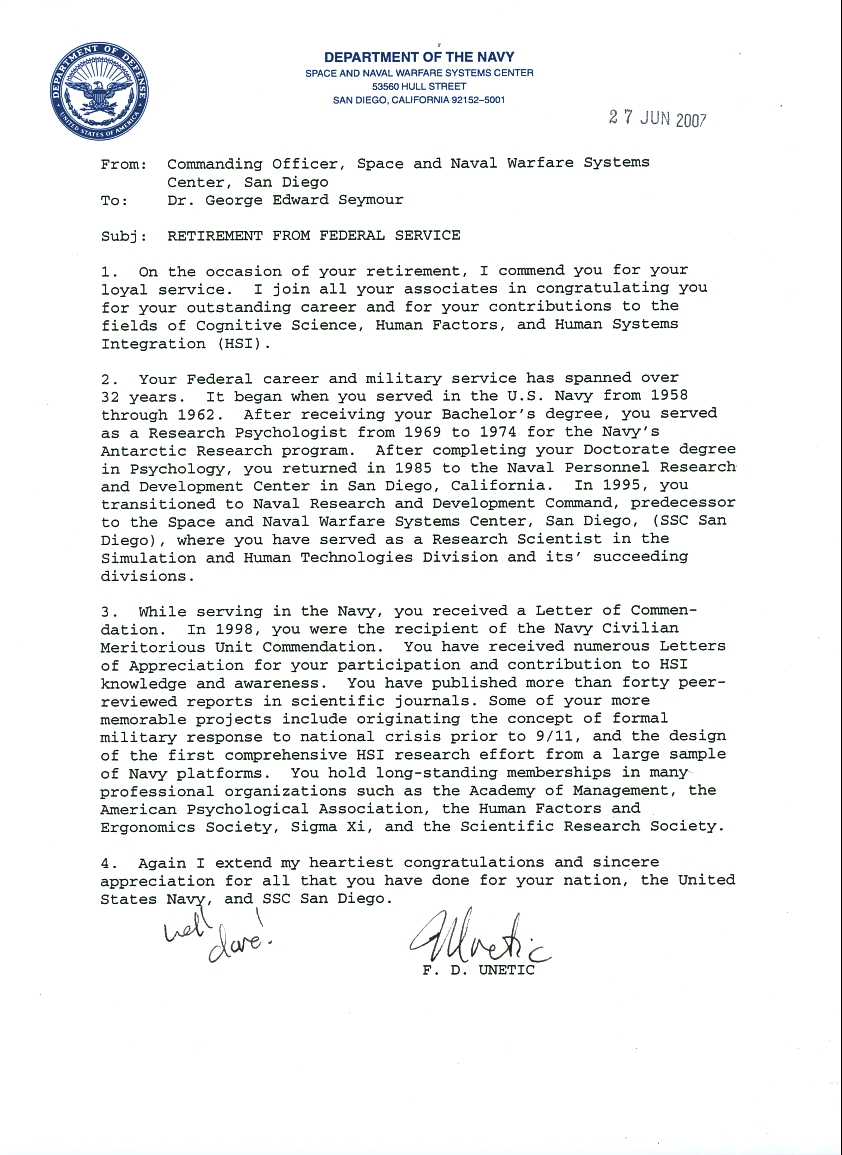
1996: Letter of Appreciation from the Commanding Officer, Naval Command, Control and Ocean Surveillance Center: RDT&E Division dated February 5, 1996.
1996: Superior Performance Award (with bonus) dated August 1, 1996 from NRaD, the research and development division of the Naval Command, Control & Ocean Surveillance Center (NCCOSC).
1997: Superior Performance Award (with bonus) dated August 4, 1997 from NRaD, the research and development division of the Naval Command, Control & Ocean Surveillance Center (NCCOSC).
1998: Recipient of the Navy Civilian Meritorious Unit Commendation dated June 30, 1998.
1998: Superior Performance Award (with bonus) from the Space and Naval Warfare Systems Center--San Diego.
1999: Superior Performance Award (with bonus) from the Space and Naval Warfare Systems Center--San Diego.
1999: Recipient of the Space and Naval Warfare Systems Center - San Diego Group Achievement Award of Merit on August 24, 1999.
2000: Listed in Who's Who in the World, 18th Edition. Marquis
2001: Letter of Appreciation from the Commanding Officer, Space and Naval Warfare System Center, San Diego: dated May 2, 2001.
2001: Superior Performance Award (with bonus) from the Space and Naval Warfare Systems Center--San Diego.
2002: Community Service Award for outstanding service associated with the Combined Federal Campaign.
2002: Department Achievement Award for contributions associated with business process improvement.
2002: Superior Performance Award (with bonus) from the Space and Naval Warfare Systems Center--San Diego dated August 5, 2002.
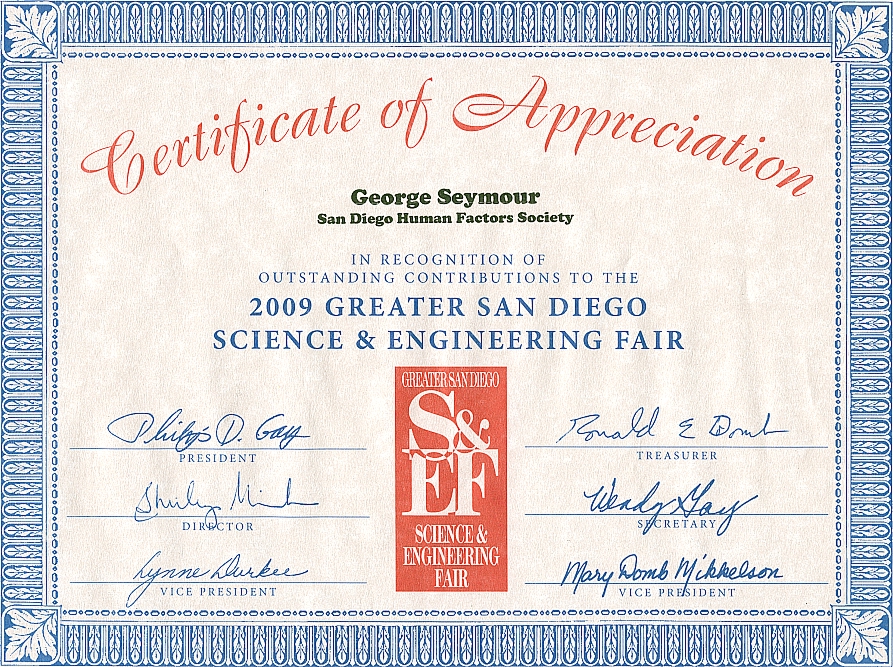
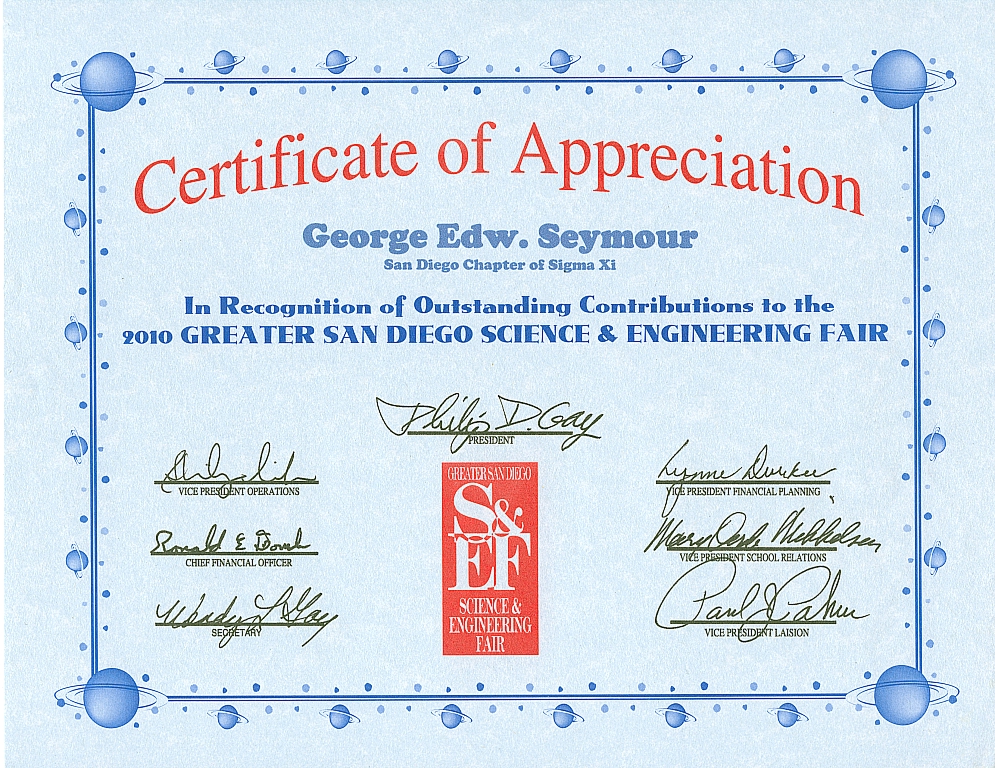
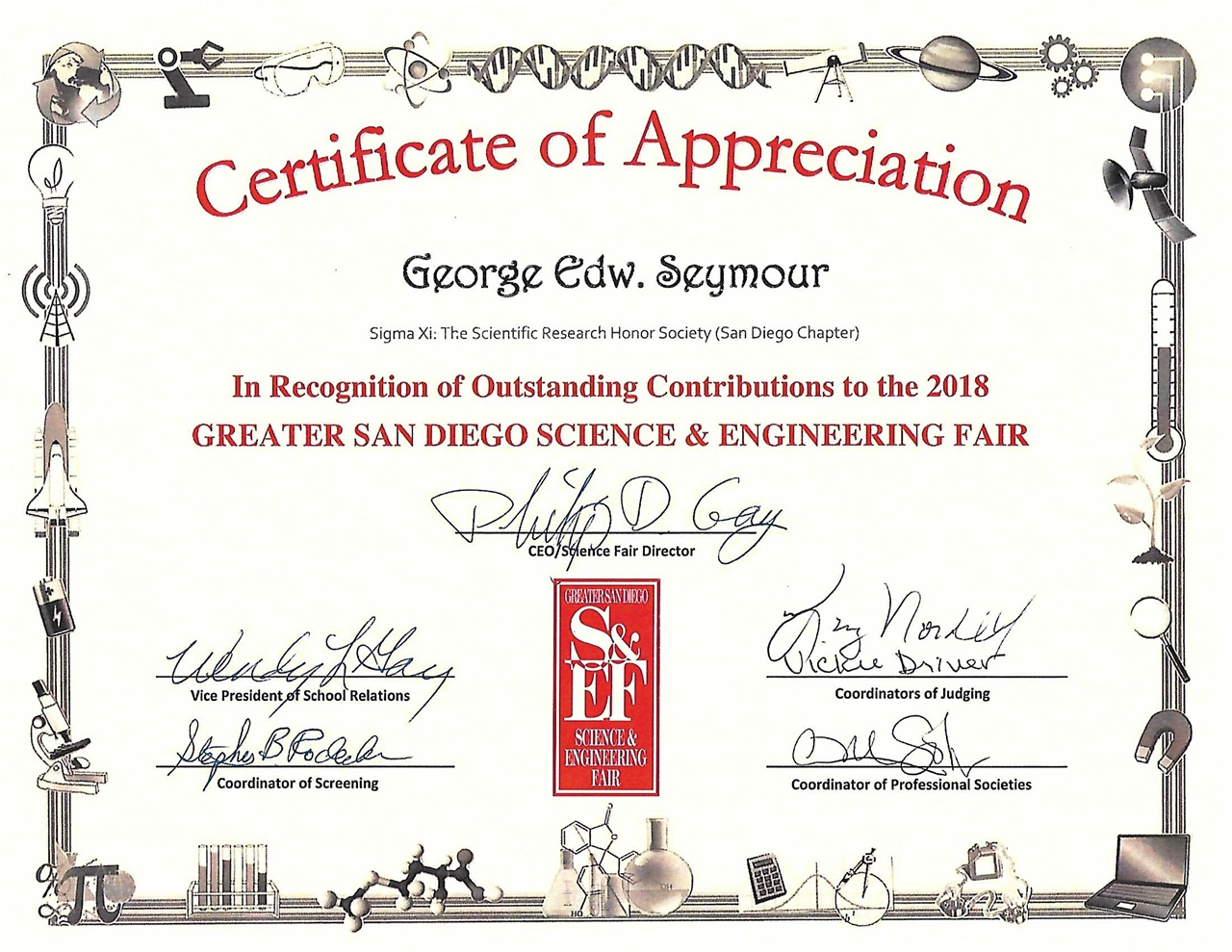
2003: Certificate of Appreciation from the Greater San Diego Science and Engineering Fair for efforts associated with student science projects.
2003: Superior Performance Award (with bonus) from the Space and Naval Warfare Systems Center--San Diego dated August 5, 2003.
2004: Superior Performance Award (with bonus) from the Space and Naval Warfare Systems Center--San Diego dated August, 2004.
2005: Certificate of Appreciation from DARPA for work supporting the Augmented Cognition Exhibits at the 1st International Conference on Augmented Cognition held in conjunction with the
the 11th International Conference on Human-Computer Interaction (HCI International 2005) on 22-27 July 2005 in Las Vegas, Nevada, USA.
2006: Superior Performance Award (with bonus) from the Space and Naval Warfare Systems Center--San Diego dated August, 2006.
2008: Certificate of Appreciation from the Greater San Diego Science and Engineering Fair for efforts associated with student project evaluations. View.
This page was revised on Wednesday, June 25, 2008.